
Reducing Misuse of Eyebrow Lamination Kit
Company
Sunsent© on Amazon
Duration
~4 weeks
Role
Product Researcher and Designer
Tools
Notion • Figma • Mural • GenAI
The Challenge
The current Instructions For Use (IFU) does not support reliable at-home eyebrow lamination, resulting in suboptimal outcomes (more than 25% of reviews are 3★ or lower).
While formulation may be a contributing factor, successful outcomes suggest the product performs when used correctly and that failures are likely driven by breakdowns in execution.
As the primary interface guiding use, the IFU is a high-leverage opportunity to reduce inconsistent outcomes.

Solution and Impact
Safe, effective, and confident use was improved by designing for instructional clarity using structured hierarchy, step-wise chunking, 1:1 mapping between solutions and actions, and clear outcome expectations to support correct execution.
Reducing misuse improves user outcomes and directly impacts cost, conversion, and product performance.
⬇️
Decrease Costs
Misuse increases returns, claims, and chargebacks—driving avoidable costs.
⬆️
Increase Revenue
Negative experiences reduce trust, lowering conversion and repeat purchase.
🥇
Improve Product Standing
Consistent outcomes drive ratings, repeat purchases, and platform visibility.
The Process
This work was structured around two research phases: Understand (to diagnose breakdowns) and Test (to evaluate the solution).

Methods are also highlighted in purple
Diagnosing the Breakdown
To understand where and why the experience was breaking down, I examined the problem across three layers: user-reported outcomes, the structure of the IFU itself, and the real-world tasks required for correct execution.
Sentiment Analysis
To understand how failures show up in real use, I analyzed 84 1★ reviews to identify recurring patterns in negative outcomes. Initial clustering helped surface common failure types, including safety concerns, ineffective results, and confusion during use.
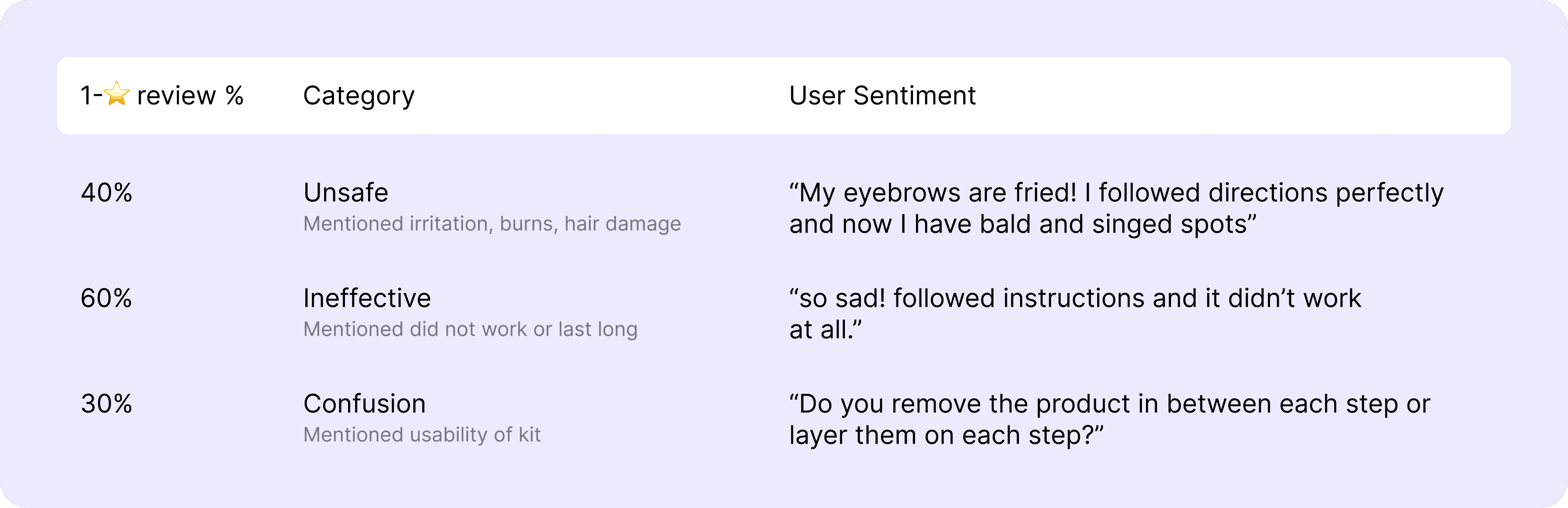
Amazon Reviews
User Experience Audit
To understand how the IFU contributes to these failures, I evaluated how instructions were structured, organized, and presented. The audit revealed that critical instructions were often buried in secondary sections, fragmented across panels, or not surfaced at all—forcing users to interpret and reconcile information during time-sensitive steps, increasing the likelihood of use error.
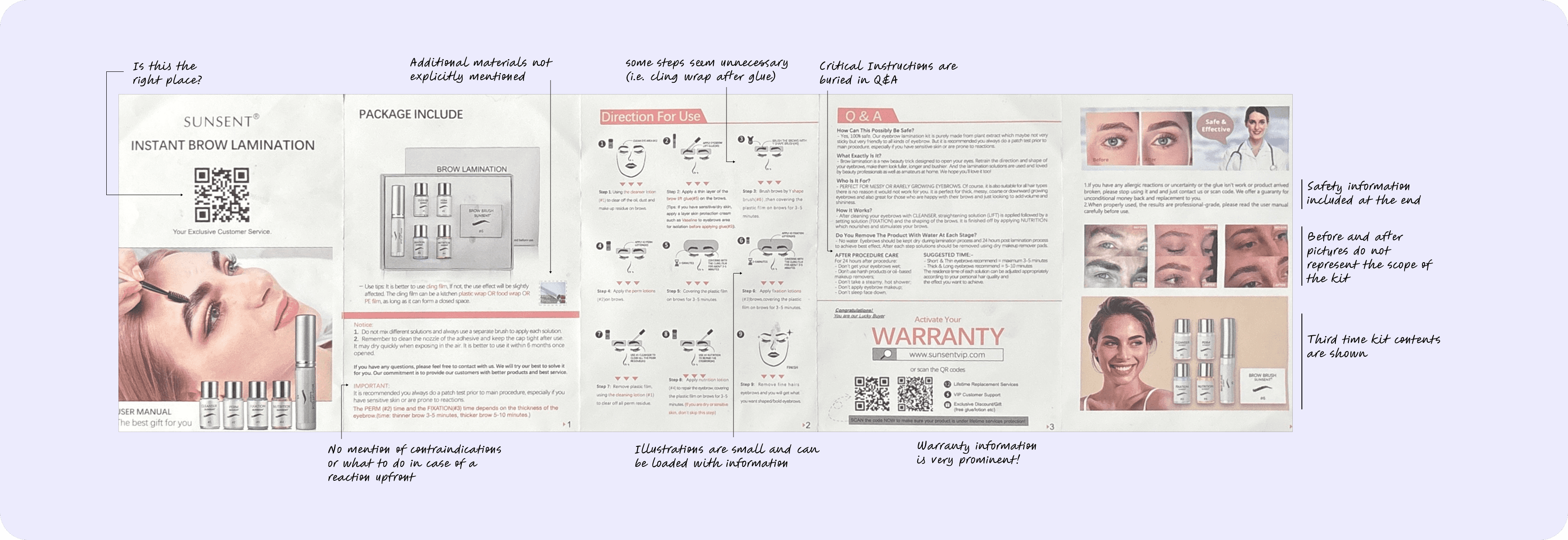
Original IFU with accordion fold
Task analysis informed by expert demonstrations and instructional references
To define what correct execution requires, I synthesized expert demonstrations and instructional references to establish a baseline for critical tasks. This revealed gaps where the IFU failed to support users at the point of need.
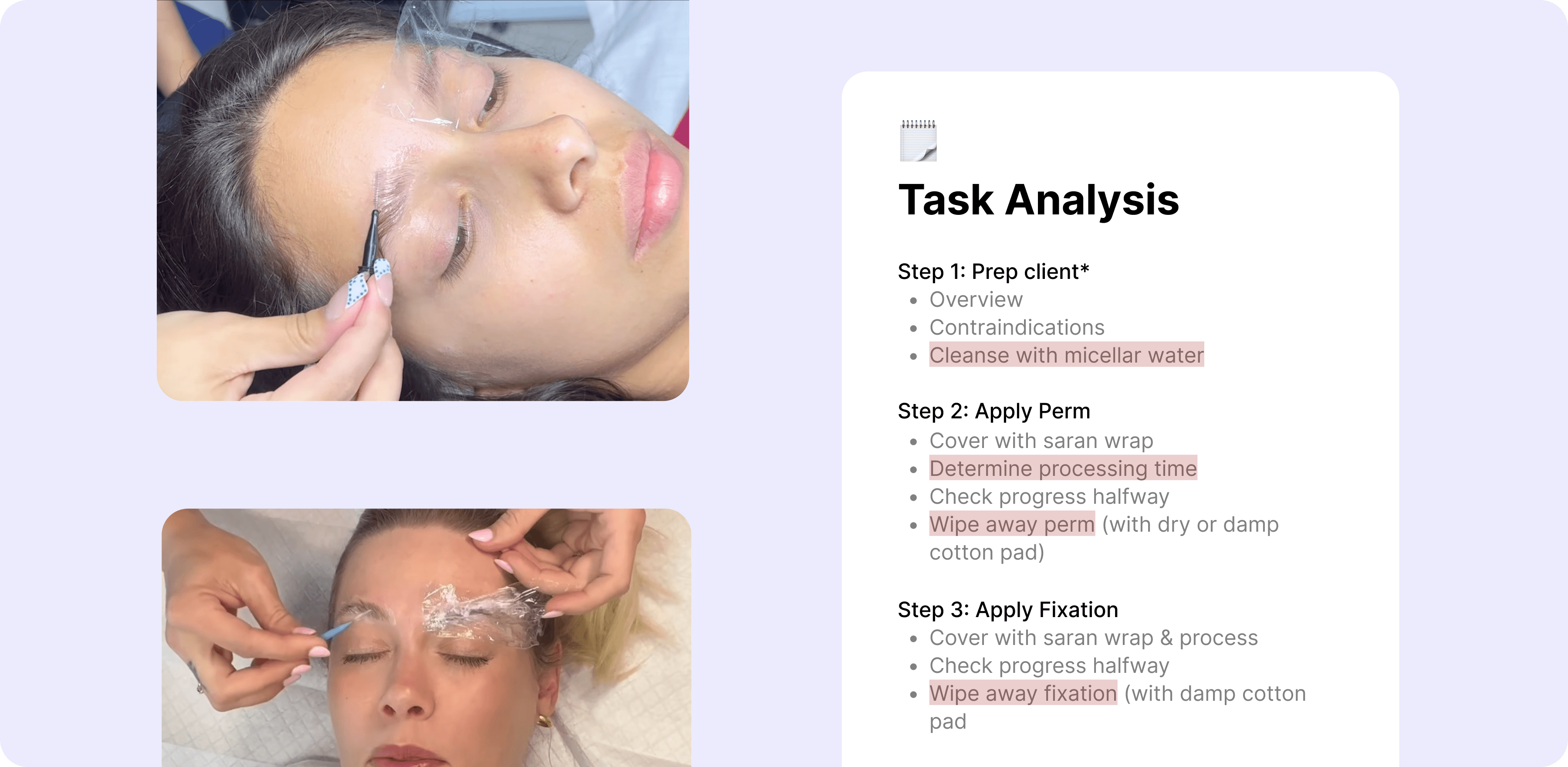
Critical tasks are highlighted in red
Design Decisions
Based on the identified breakdowns, I redesigned the IFU to improve execution by restructuring how information is organized, presented, and sequenced during use. These decisions were intended to reduce cognitive load, clarify actions, and better support users during time-sensitive steps, and were treated as hypotheses to be evaluated through usability testing.
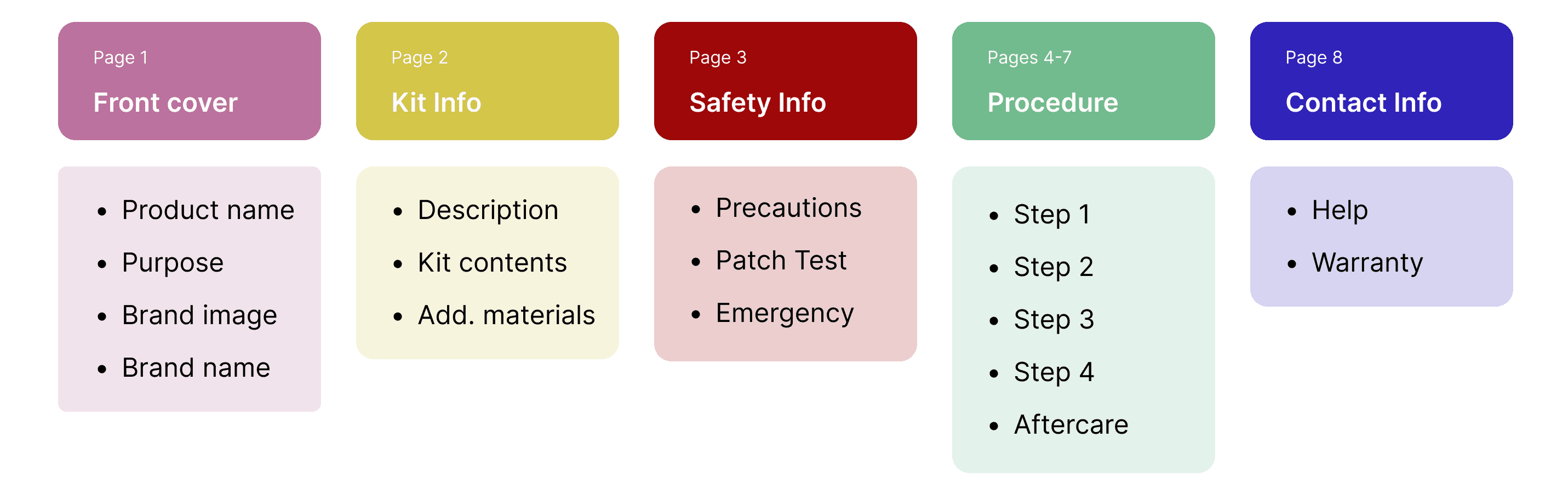
Folds: Cover, Gate to prep, Procedure, Back
Decision 1 — Cognitive ease through information hierarchy
To address buried and fragmented information, I restructured the IFU so that critical content appears in the right place at the right time. Information was organized into a clear hierarchy separating orientation (kit info, safety) from execution (procedural steps) to reduce scanning and support navigation during use. The structure aligns with industry and regulatory expectations for clear, sequential instructions.
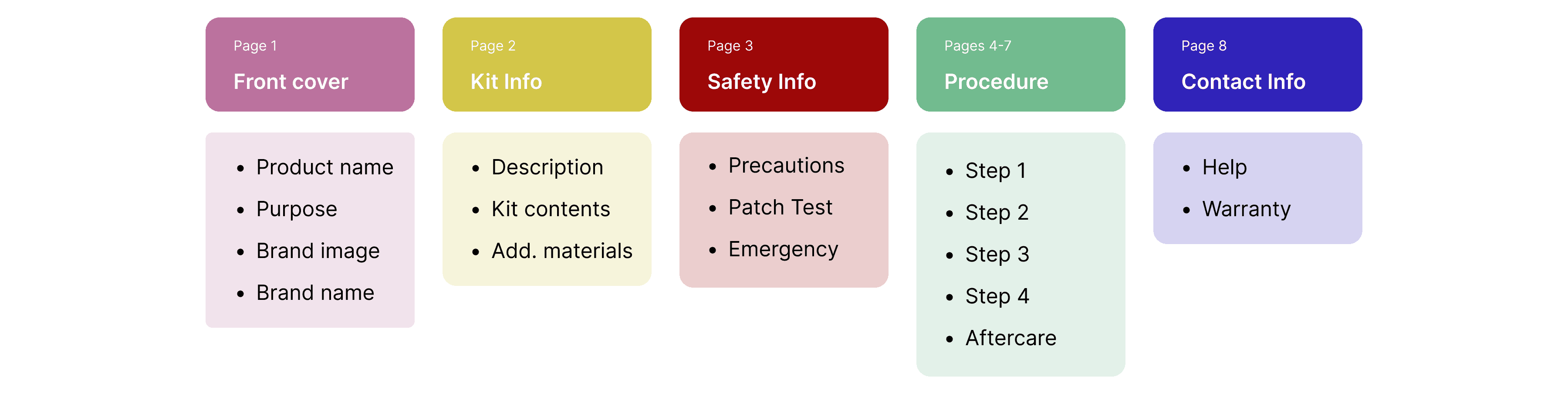
Decision 2 — Progressive disclosure through a double gate fold layout
To further reduce cognitive load during execution, I introduced a double gate fold to support progressive disclosure.
The outer panels orient users with expectations, safety, and required materials before they begin.
Once opened, the inner panels present the procedure in a clean, uninterrupted sequence.
This allows first-time users to prepare upfront, while enabling repeat users to quickly access the steps.
Decision 3 — Instructional clarity through step chunking and 1:1 mapping
Lastly, I restructured instructions into four discrete steps with a 1:1 mapping between each step and its corresponding solution, establishing a clear step structure to reducing variation in execution.
Evaluative Research
To evaluate whether the redesigned IFU improved execution, I conducted a series of tests with 5 participants. All participants completed the procedure without error and rated the IFU as easy to follow (average rating: 2.2/5, where 1 = very easy).
Testing also revealed opportunities to better support orientation, reduce perceived complexity, and improve recall of key steps.
Methodology & Recruitment
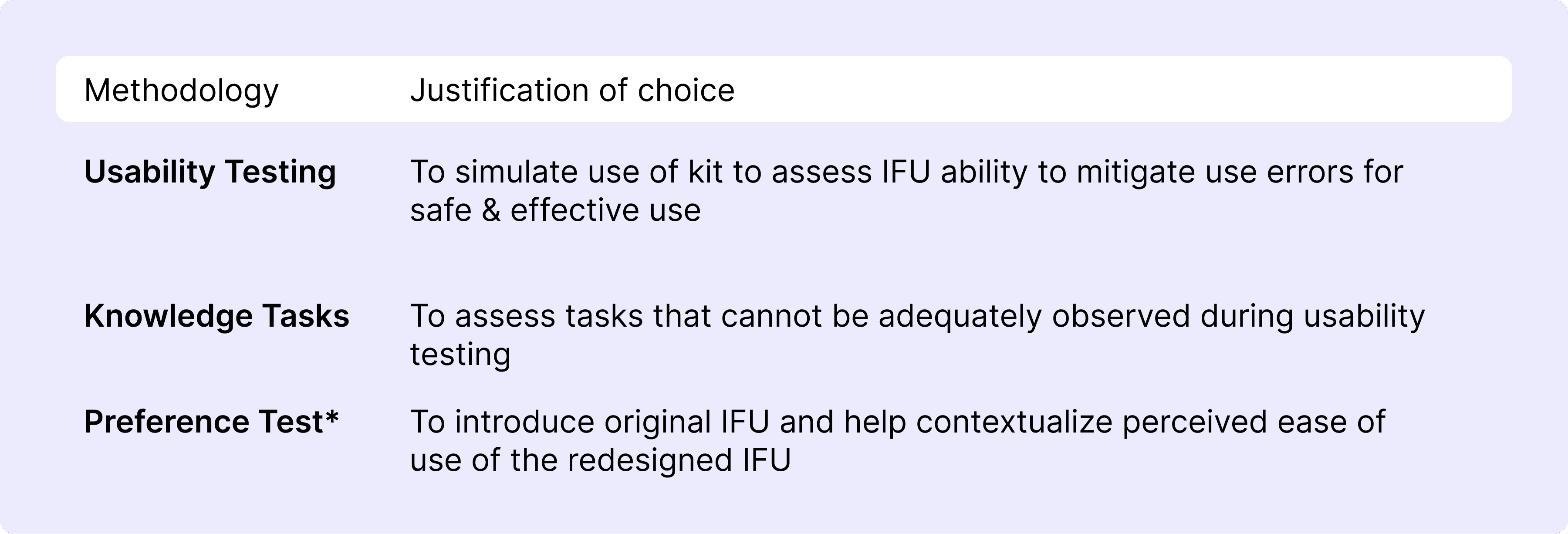
To evaluate the IFU, I conducted simulated-use usability testing with 5 participants, complemented by knowledge-based tasks and a preference test.
The 5 participants had varying experience with at-home perming procedures (e.g., hair perming; 1 with professional brow lamination experience), representing starter kit users who may have limited direct experience and rely on instructions to guide correct execution.
Translating Insights into Actionable Recommendations
Findings from usability testing are paired with design recommendations to address observed breakdowns and inform iteration.
1
Recommendation: Change layout from Double Gate, back to Accordion Fold or into a mini-Booklet
Gate Layout does not seem to be the best option to help orient and prepare users before the procedure.
Only 3 out of 5 users acknowledged information in the gate before moving on to the procedure.
The other two missed information completely before recovering, and both rated IFU as "neutral" with 3 out of 5 rating.
Upon opening the full spread, some users perceived the procedure as having many steps, indicating that simultaneous exposure to all steps may increase perceived complexity.
2
Recommendation: Break aftercare into bullets to allow for better recall
Summarizing aftercare in paragraph format made it harder for participants to recall the second action.
3
Recommendation: Introduce before and after illustration
All participants vocalized strong appeal for the original IFUs use of before and after pictures. Although the illustrations in redesigned IFU do show progression of the brow, a dedicated “before and after” illustration can help serve as a better definition of done


Reflection & Learning
This project was a reminder of how important it is to validate designs before launching them to a broader audience. Decisions that felt intuitive and logical during design were quickly challenged once I put the IFU in front of users. It reinforced the importance of putting designs in front of users early and often!