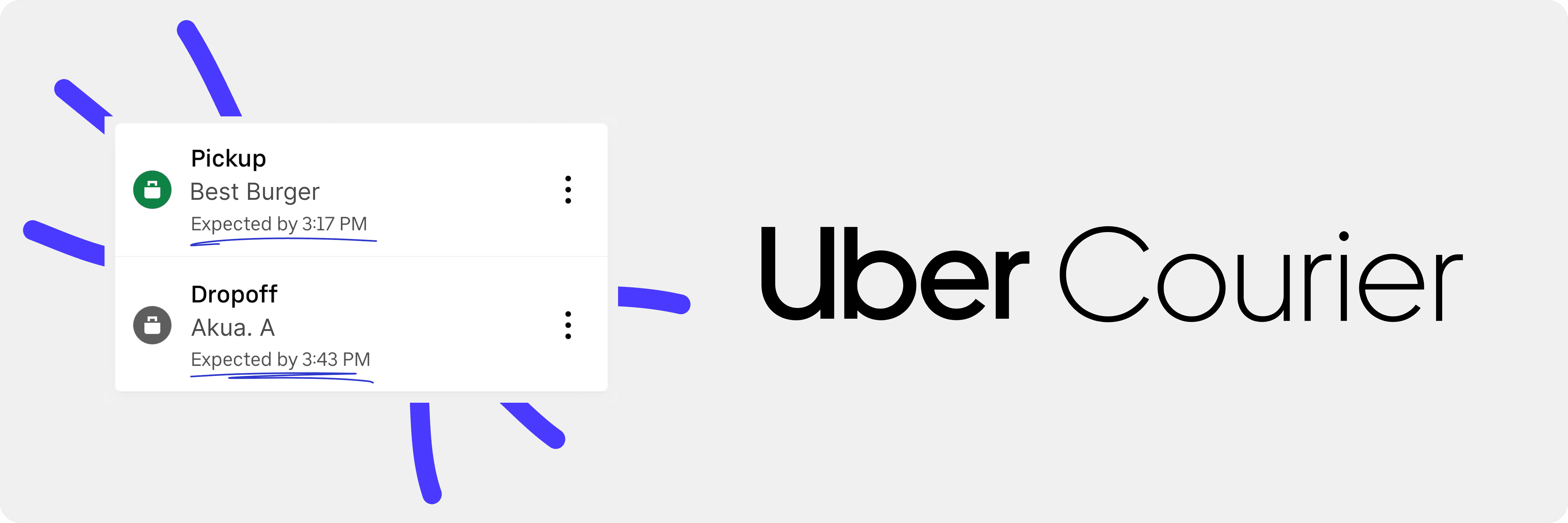
More on-time deliveries with Pickup and Drop off timelines
Company
Uber
Team
Maps Team, Product Designer, Content Designer, ResearchOps, Engineers, Data Scientist, ProductOps
Role
Product Manager and Researcher
Tools
Docs, Zoom, Otter.ai
The Old Experience
Delivery time is communicated to the customer but not visible to couriers. Couriers are unaware of when customers expect them, leading to late deliveries.
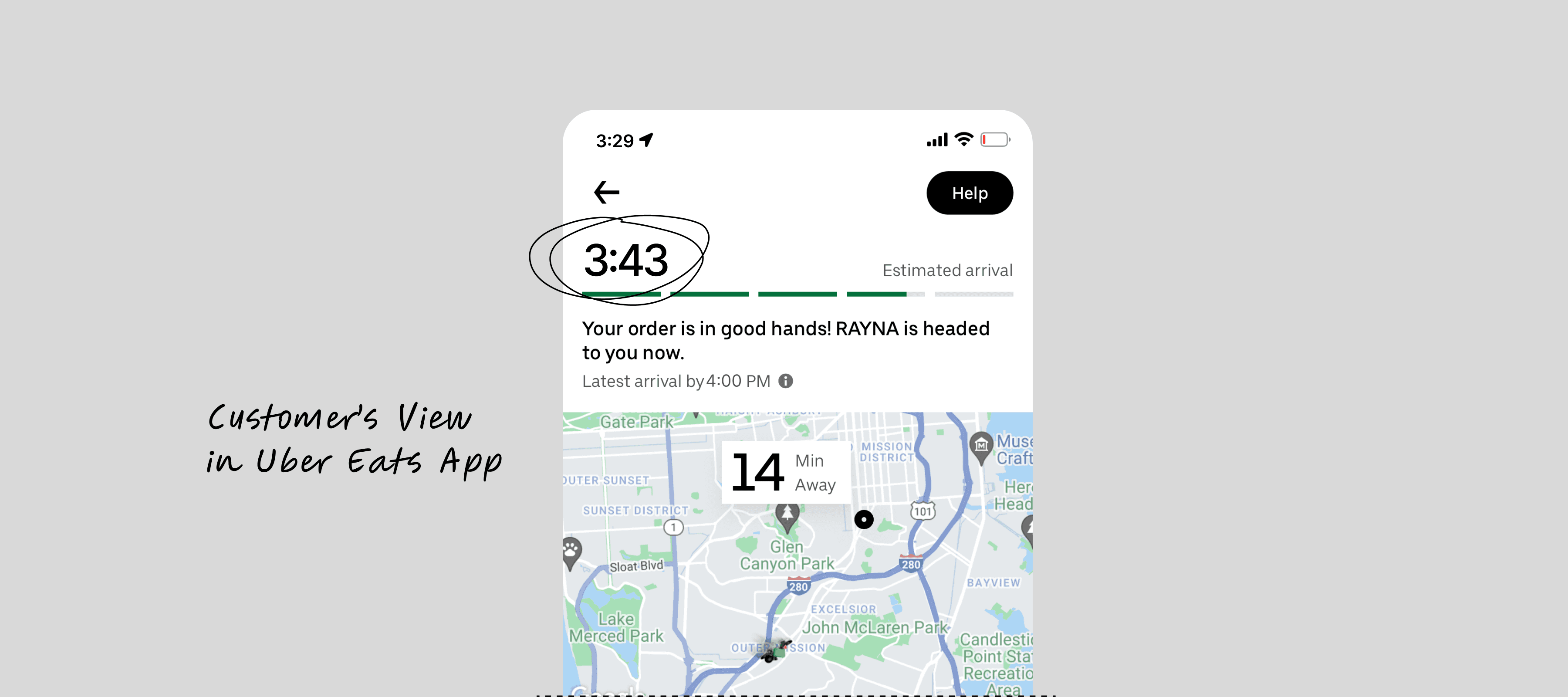
The New Experience
Addition of pickup and dropoff timelines to give couriers visibility into customer expectations and help them make informed decisions to arrive on time.
The Challenge
Even after several product and design reviews highlighted clear gains in transparency for couriers, leadership remained cautious, citing concerns that introducing timelines into the navigation experience could create confusion with ETA or add unnecessary pressure while driving.
Solution and Impact
To address these concerns, we shifted the focus from whether timelines should exist to how they could exist responsibly within the navigation experience.
I partnered with the product manager on the Maps team to develop a structured response that addressed leadership concerns and de-risked the launch.
This included usability testing to validate if couriers understood and perceived timelines as guidelines (vs strict deadlines) and a phased rollout approach which allowed us to introduce timelines incrementally, mitigating risk on a high-exposure surface.
This approach enabled us to secure approval to launch with full scope.
Post-launch results revealed that customers are receiving their food earlier (leading to less cancellations) and Couriers are completing more trips in the same amount of time (spending less time per trip at scale).
💰
+$12.4M
Annual est. cost savings
✅
-9.2%
Customer cancellations
⌛️
0.25%
Per completed trip
The Process
I collaborated with the Maps team to get an understanding of the problem, defined the user experience that sits on top of the logic layer, led reviews for product approval, orchestrated cross-functional collaboration, and rallied a team to validate design through usability testing, and launched to markets globally.
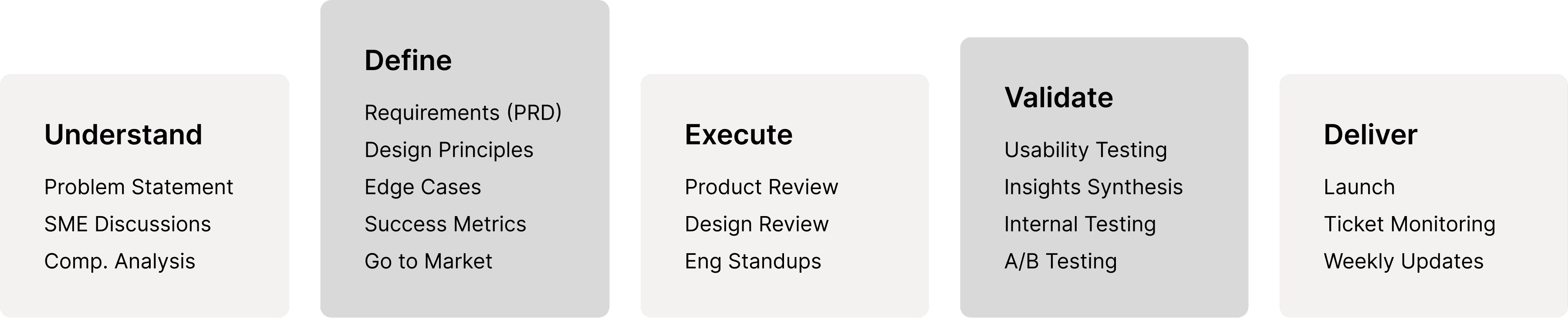
Highlighted categories detailed below!
Defining the Product
Our Partner team, Maps, brought the lateness problem to the Courier Experience team. Together, we aligned on timelines as the appropriate solution. Maps owned the calculation and logic layer, while my team was responsible for how those expectations would be presented to couriers.
Maps defined a conservative calculation to ensure that an overwhelming majority of couriers would be able to meet the expected time. My focus was then on how to translate this into a thoughtful experience that balanced clarity with care, minimizing pressure while supporting informed decision-making.
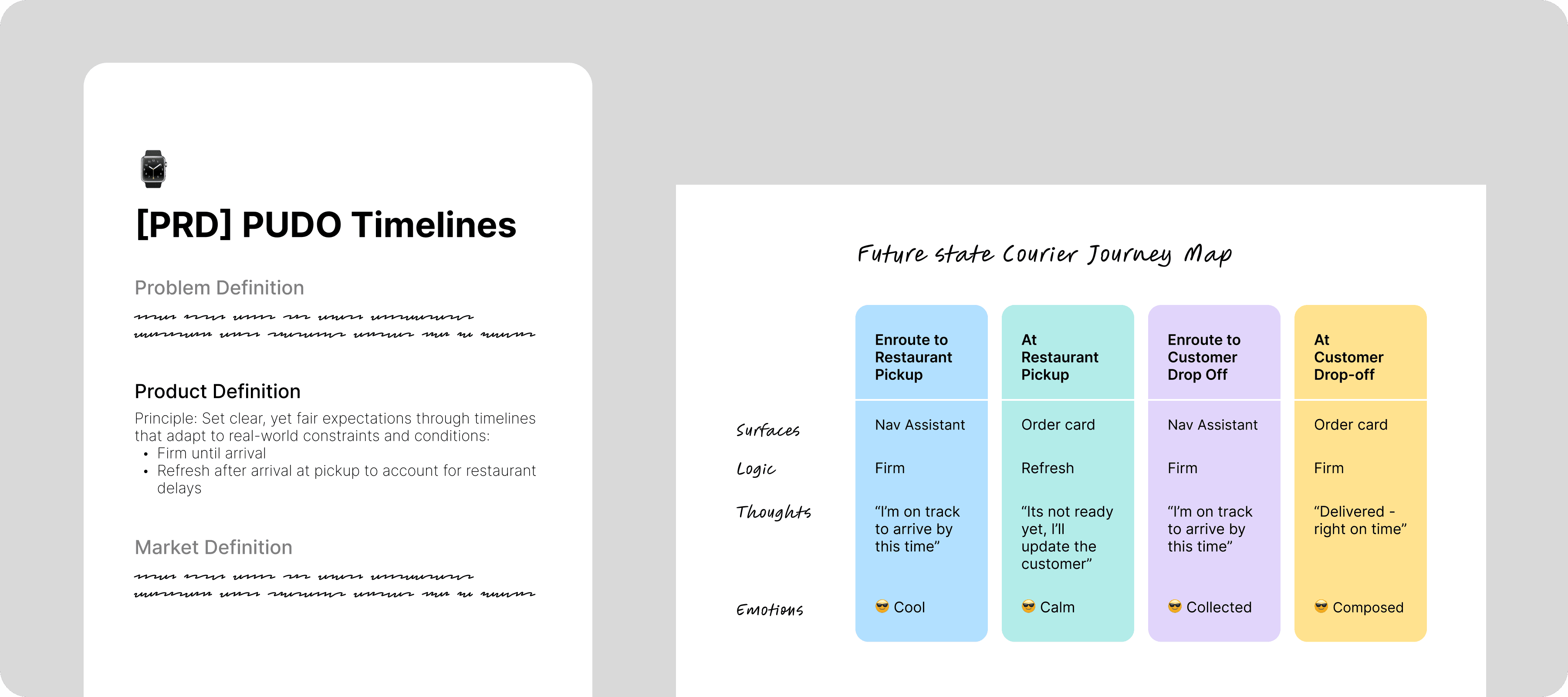
Example of Product Requirements Document (PRD) & artifiacts
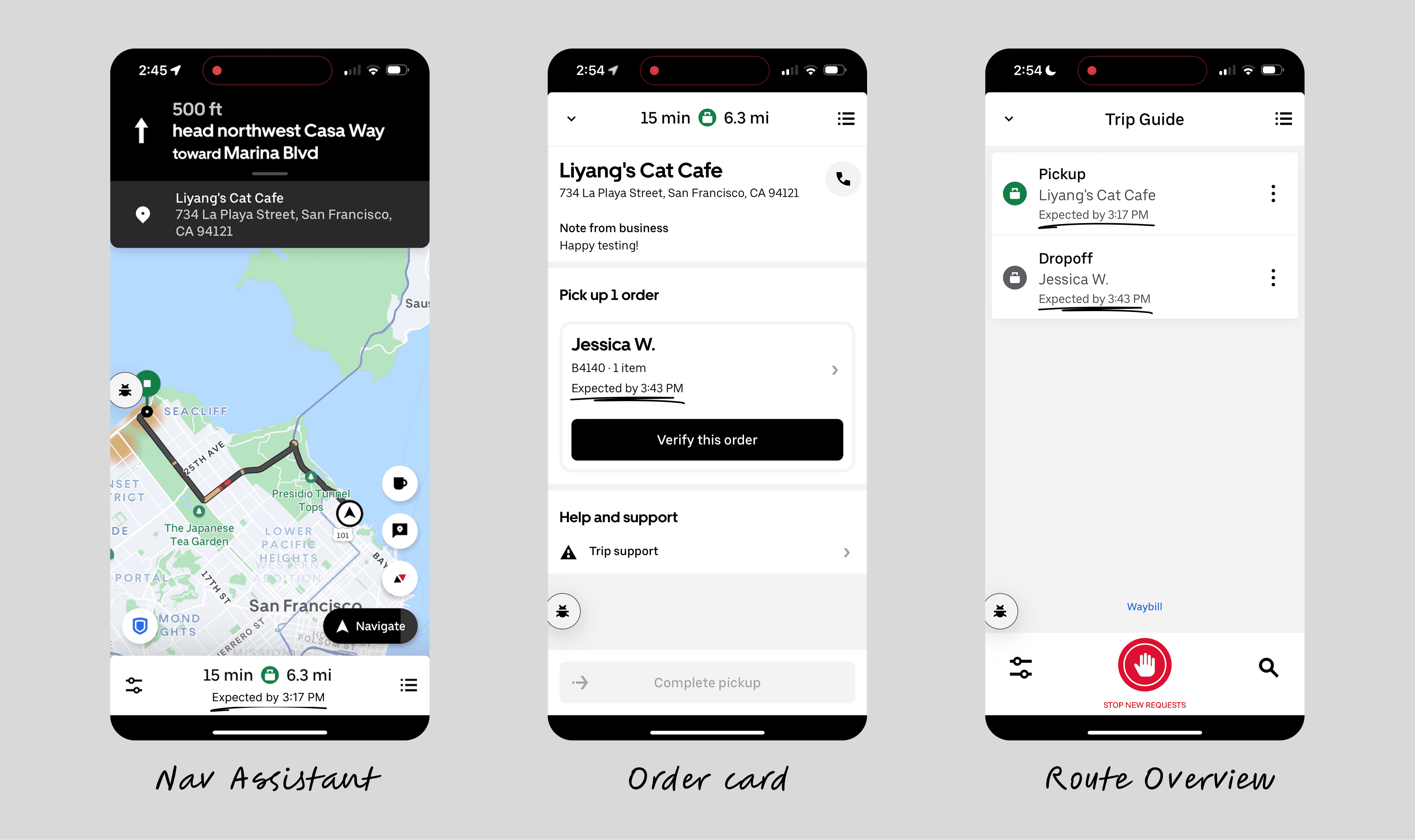
Decision 1 - Determining Surfaces
Why navigation bar?
The navigation surface is what couriers rely on while en route to their next stop, making it the earliest and most relevant opportunity to introduce expectations. I chose this surface because it is non-intrusive and already supports lightweight messaging, unlike alerts or pop-ups that could disrupt couriers while driving.
The goal here was to provide timely visibility into expectations so couriers can adjust their behavior before arrival. Introducing expectations only at the restaurant would be too late to influence behavior.
Constraint: This surface competes for limited real estate and rotates with other messages, reducing visibility. However, this tradeoff allowed expectations to remain subtle and non-intrusive.
Why order card?
Once couriers arrive, the order card becomes the primary surface for interaction. At this point, the context shifts, from navigating to a location to completing a task.
I used this surface to reinforce drop-off expectations within the context of the customer. This is particularly important in batched orders, where each leg will have a different destination (hence different calculation) and cannot be represented by a single universal time.
Why Route Overview?
The route overview provides a high-level view of the full trip, making it the right place to summarize expectations across all legs and support planning.
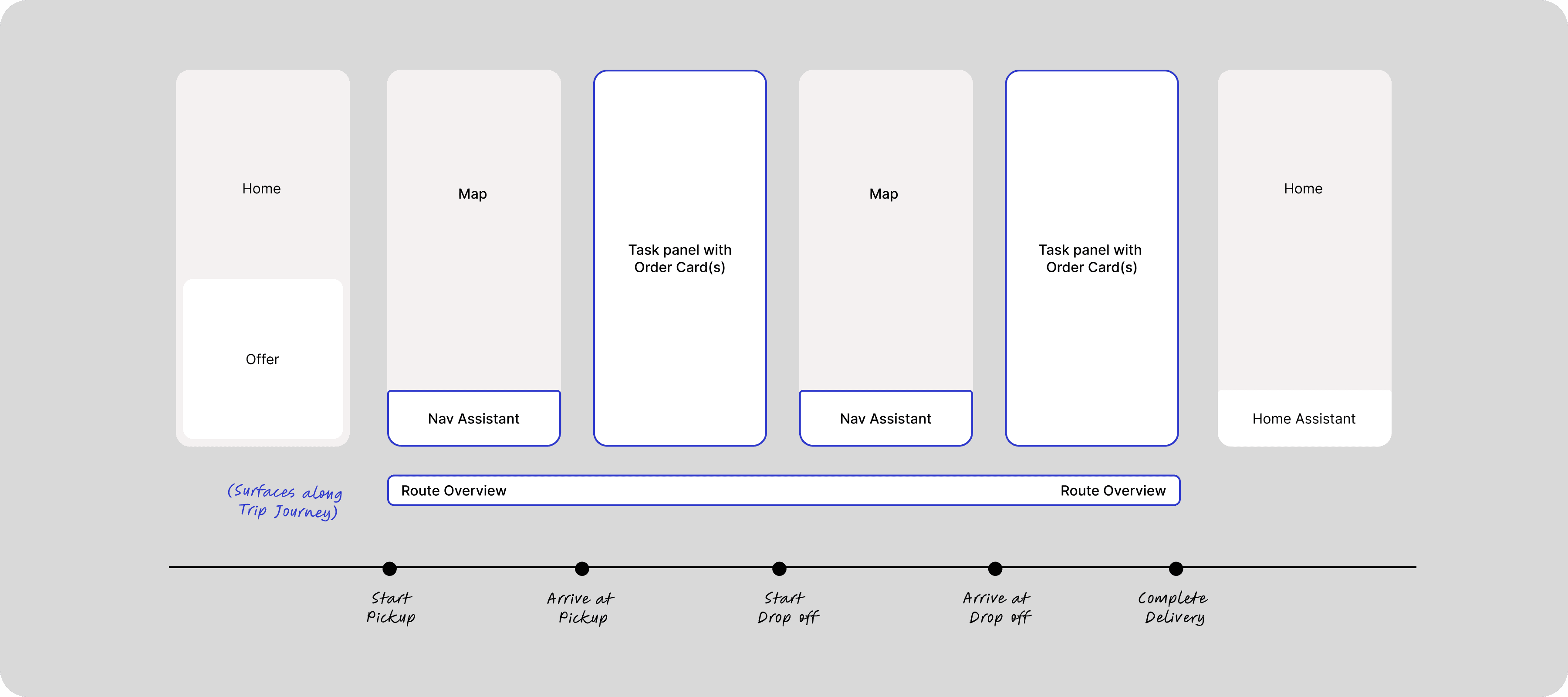
Surfaces in relation to Trip Journey
Decision 2 - Crafting clear copy
I partnered with a content designer, framing expectations as arrival guidelines rather than strict task deadlines to avoid creating unnecessary pressure for couriers. Phrasing like “Pickup/Dropoff by…”, which is commonly used in other delivery experiences, implies accountability for completing a task that isn’t always within the courier’s control (e.g., restaurant delays).
Instead, we adopted “Expected by…”, aligning with broader industry conventions (e.g., package delivery), and relied on contextual surfaces to convey meaning (pickup vs. drop off).
Decision 3 - Handling Edge Cases
I chose not to introduce a separate treatment for past-due expectations in this phase, focusing on establishing clear, consistent expectations upfront. More complex handling of past-due scenarios was deferred to future iterations.
Validating Product Decisions
To drive alignment with leadership and move forward with confidence, I led a focused, two-week validation effort to pressure-test key product decisions. An initial attempt using intercept interviews proved insufficient, so I pivoted to a more structured usability testing approach to assess comprehension, perception, and decision-making.
Methodology
I chose formative usability testing to evaluate how couriers understand and perceive pickup and drop off timelines within realistic task scenarios — enroute, at pickup, and during first-time education (FTUX).
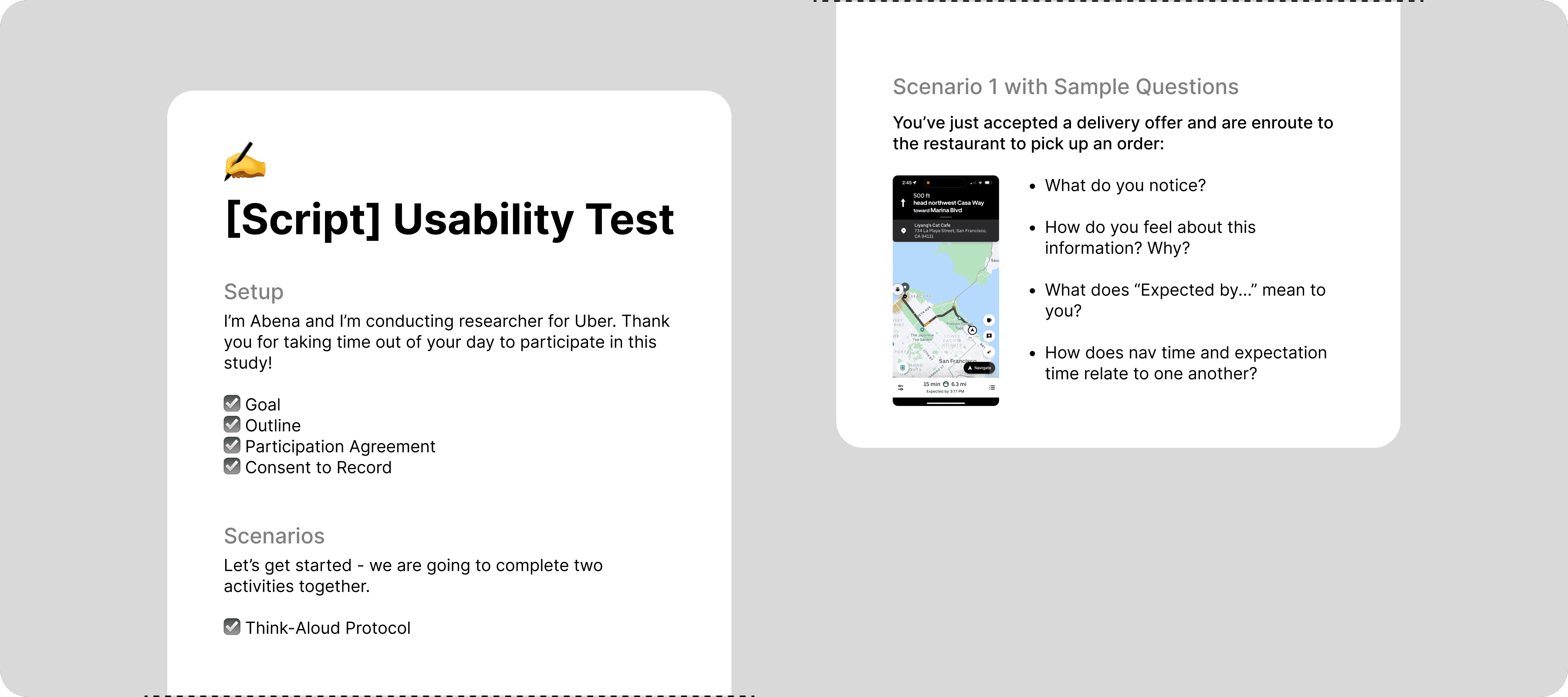
Script with sample questions
Recruitment
Attempt 1 — Intercept Interviews
I initially used an intercept approach at the Greenlight Hub in Oakland, an in-person support center where drivers and couriers activate accounts and receive help with app issues.
This approach was intended to quickly recruit participants for informal usability sessions.
However, it proved ineffective for this study, as the population skewed heavily toward drivers, limiting access to the target user group.
Attempt 2 — Targeted recruitment via Research Ops
Learning from my mistakes, I pivoted to a more structured recruitment approach in partnership with Research Ops.
I defined participant criteria to ensure relevance to the study, including a mix of new and experienced couriers who had completed at least five deliveries in the past week.
This approach resulted in 12 qualified participants. To move quickly, I coordinated 5 volunteer moderators (the same colleagues from the initial attempt including myself) to run parallel sessions.
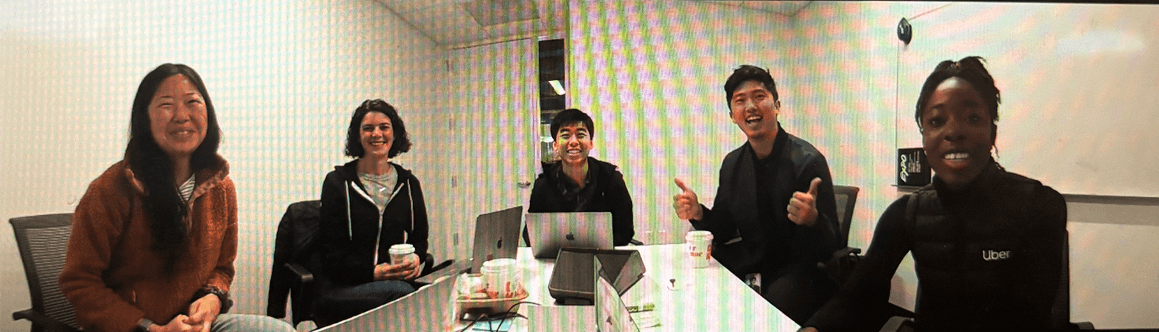
Moderators from left to right: Content Designer, Manager, ProdOps, Partner PM, & Me
Translating Insights into Action
After synthesis, I shared findings with leadership and partnered with engineering to refine the experience before launch.
Overall, couriers understood the concept of timelines and felt the added visibility helped clarify what customers expected of them. The testing also surfaced a few areas where the experience needed to be clearer.
1
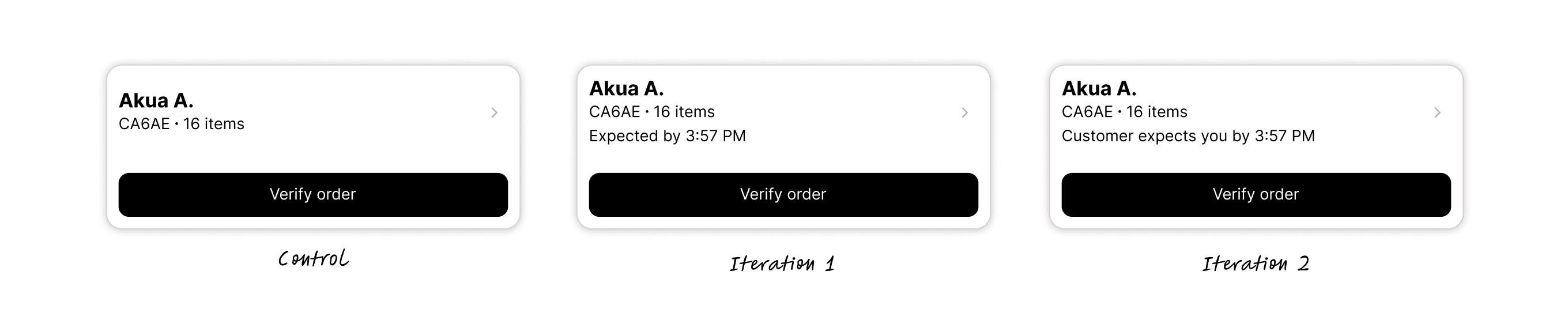
Action: Clarified timelines on order card from "Expected by" to " Customer expects you by…"
Although couriers understood that the timelines in the navigation bar were contextual to arrival…
Many couriers did not understand that the order card expectation, "Expected by…" was the time that customers were expecting them. Couriers thought it was the time that the food would be ready for pickup.
2
Action: Added more information about how expectations are calculated in education
Received well, although two couriers mentioned they would feel a "little pressure, although normal when given a deadline," and that expectations would change the "tone or atmosphere" of the platform, making the delivery experience "less relaxed".
3
Action: Made policy more accessible by adding a link to education
Couriers are aware that there must be some policy on timeliness, but unsure of the details or what exactly constittutes lateness
Reflections & Learnings
On Ownership
I learned the importance of maintaining clarity and direction, even in the face of strong feedback. By staying grounded in the problem, goals, and success criteria, I was able to evaluate input thoughtfully without losing direction and create alignment by clarifying guiding principles and identifying a path to de-risk key decisions.
On Recruitment Strategy
I learned that selecting the right method is only part of the equation—its effectiveness depends on having the right setup. While usability testing was the appropriate approach, the intercept format limited access to the right participants and the ability to evaluate the experience. I learned the importance of aligning method, recruitment strategy, and study design to the problem, especially when evaluating more complex experiences.